

Southern University of Science and Technology (SUSTech) is an innovation-oriented public university founded by Shenzhen government in the background of China's higher education reform. It aspires to be a model and pioneer for promoting higher education reform. It is committed to serving the mission of promoting Shenzhen as a modern, international, and innovative city and China as a creative country.

SUSTech is widely regarded as a trailblazer and innovator in advancing China's higher education. It was officially approved by the Ministry of Education in April 2012. SUSTech bears the responsibility for exploring and developing a modern university system with Chinese characteristics to serve as a model for cultivating innovative talents. SUSTech aims at a globally renowned university that contributes to the advancement of science and technology. It nurtures promising and creative leaders who excel in interdisciplinary research and creating knowledge for the world.
SUSTech draws on the experience of world-class science and engineering universities for its disciplinary establishment and governance. It focuses on science, engineering, and medicine in conjunction with distinctive disciplines, including business, humanities, and social sciences. SUSTech offers undergraduate and postgraduate education while conducting research in a series of innovative disciplines. All of those practices shape SUSTech into a think tank for social progress and a generator of new knowledge and new technology.
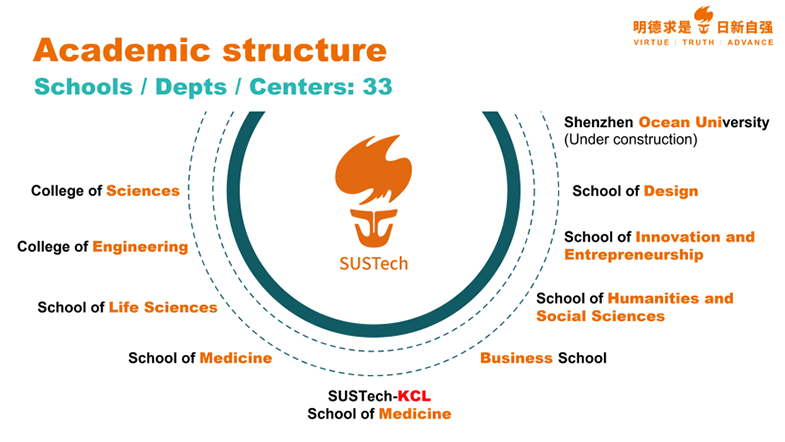
SUSTech is building interdisciplinary research centers to generate new scientific and technological wisdom in cross-disciplinary fields such as artificial intelligence, life sciences, Internet of things, robotics, new energy, and intelligent manufacturing.
In the spirit of "For Truth, Innovation, Reform and Excellence with Diligence and Courage," SUSTech highlights "research, innovation, and entrepreneurship" and dedicates to facilitating innovative projects across China and turning Shenzhen into an innovative, modern, and international metropolis.
SUSTech also seeks to become an international high-level research university that gathers first-class faculty and nurtures top-notch innovative talents. It aims to produce internationally recognized academic achievements and advance scientific and technological applications.
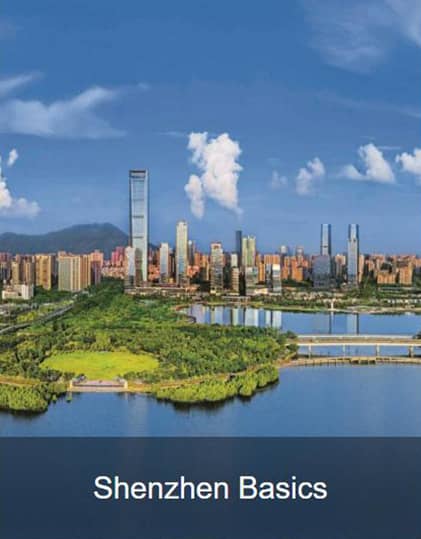
Shenzhen was established in March 1979. In August the following year, the city was turned into the country’s first special economic zone. Over the past four decades, Shenzhen has transformed from a small backward border town into a modern and international metropolis, creating a miracle in the history of world development. In August 2019, the CPC Central Committee and the State Council issued the Guidelines on Supporting Shenzhen in Building a Pilot Demonstration Area of Socialism with Chinese Characteristics, and the city was once again presented with a new major opportunity and a powerful mission. In accordance with the requirements of building “a model city of high-quality development,” “a model city under the rule of law,” “a model city of urban civilization,” “a beacon for people’s wellbeing” and “a vanguard of sustainable development,” Shenzhen is striving to continue to create new and greater miracles that will impress the world.
Shenzhen is committed to building a globally influential economic hub by continuously accelerating the construction of an advanced manufacturing center, a technology innovation center, a consumption center, a logistics center and a financial center with global influence.
By 2025, Shenzhen will be among the top global cities in terms of economic strength and quality of development, possessing world-class R&D investment intensity and industrial innovation capacity. The city will see a significant increase in cultural soft power with its level of public services and ecological environment quality reaching internationally advanced levels, and the city will become a modern, international and innovative city. By 2035, Shenzhen’s high-quality development will be a national model, and it will lead the world in comprehensive economic competitiveness. Shenzhen will become an innovative, entrepreneurial and creative city with global influence, becoming an exemplary city for building a modern socialist country. By the middle of this century, Shenzhen will stand out as one of the world’s advanced cities and become a global benchmark city with outstanding competitiveness, innovation and influence.
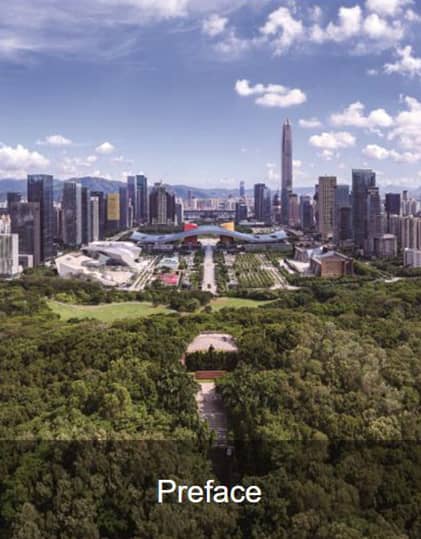
Adjacent to Hong Kong, Shenzhen is a coastal city in southern Guangdong Province located on the east bank of the Pearl River Estuary. To the east of the city are Daya Bay and Dapeng Bay, while the Pearl River Estuary and Lingding Bay lie to its west. Shenzhen River connects Hong Kong to the south, and to the north of Shenzhen are the cities of Dongguan and Huizhou. Its longitude lies between 113.43 and 114.38 degrees east, and its latitude lies between 22.24 and 22.52 degrees north. Covering a total area of 1,997.47 square kilometers, its subtropical monsoon climate brings warmth and plenty of precipitation to the city.
City area: 1,997.47 sq km
Coastline: 260.5 km
Total marine water area: 1,145 sq km
Annual average temperature: 23.0°C
City trees: litchi tree and mangrove tree
City flower: bougainvillea
Division
Shenzhen has nine administrative districts and one new area: Futian District, Luohu District, Yantian District, Nanshan District, Bao’an District, Longgang District, Longhua District, Pingshan District, Guangming District, and Dapeng New Area. On December 16, 2018, the Shenshan Special Cooperation Zone in Shanwei City was officially inaugurated.
Population
As of the end of 2022, Shenzhen had 17.66 million permanent residents. As a young immigrant city, Shenzhen has been a magnet for innovative, entrepreneurial and creative talents from all over the world. According to the seventh national population census, the average age of Shenzhen residents was 32.5.
Language
The mainstream language in Shenzhen is Mandarin Chinese, also known as Putonghua. Cantonese and English are also widely used. Some public service institutions may provide multilingual services. Citizens from all over the country also use local dialects for communication.
Economy
In the first half of 2023, Shenzhen’s GDP reached 1.63 trillion yuan with a year-on-year growth of 6.3%, and its import and export volume was 1.68 trillion yuan, up 3.7% from last year.
GDP
In the first half of 2023, Shenzhen’s GDP reached 1.63 trillion yuan.
Foreign Trade
In the first half of 2023, Shenzhen’s import and export volume was 1.68 trillion yuan.


